AI Driven UI Design: High-Speed Production for Modern Makers
Ditch slow mockups. Master AI driven UI design to generate production-ready React components and bridge the design-to-code gap for high-speed production.

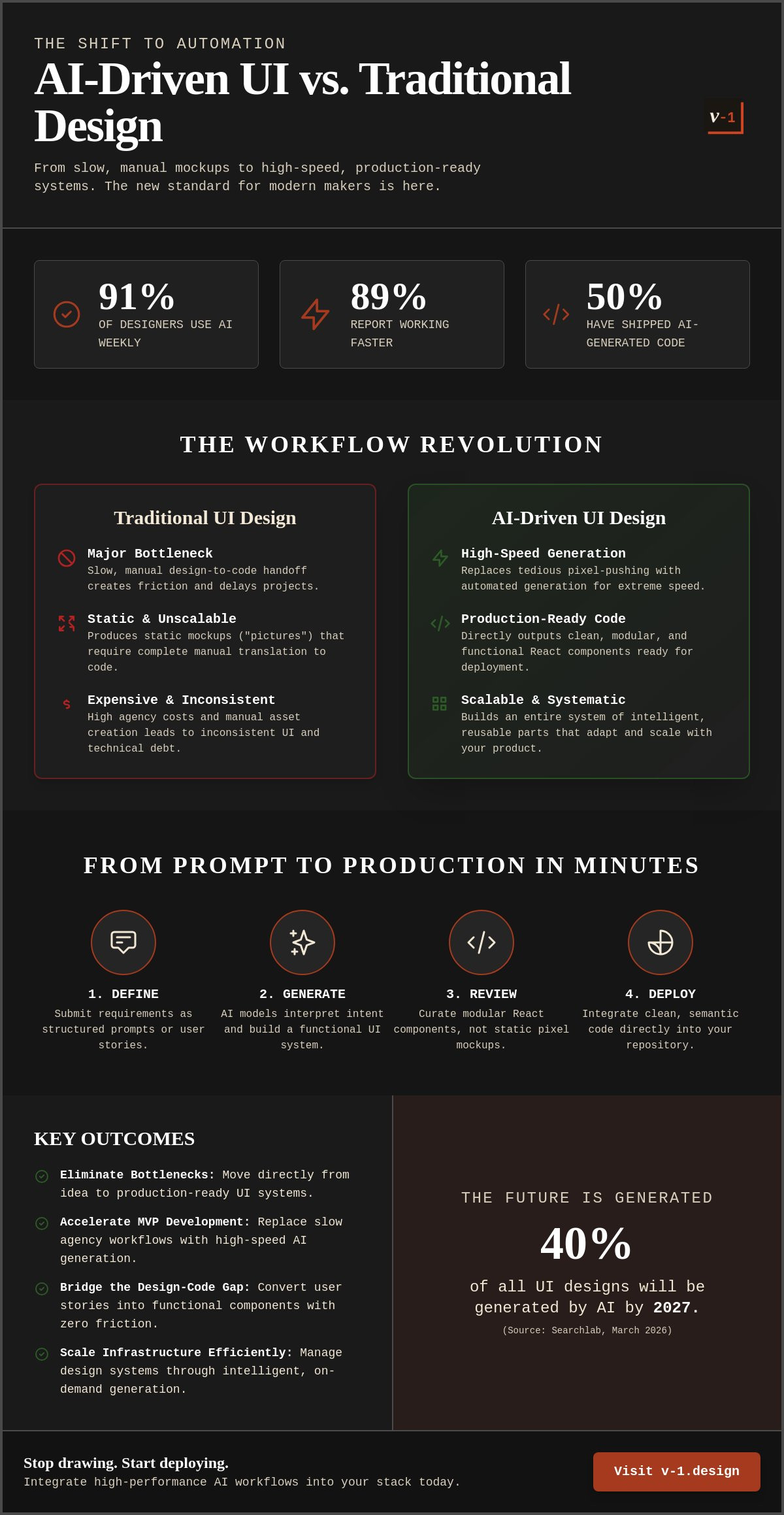
91% of designers now use AI tools every single week to ship better work. It's a massive shift. You've felt the friction of the traditional design-to-code handoff. It's slow. It's manual. It's a bottleneck for technical teams who need to move fast but lack dedicated design resources. AI driven UI design is the solution. It replaces tedious pixel-pushing with high-speed generation. 89% of designers report working faster with these tools integrated. You aren't just making mockups; you're building the engine.
You're here because manual iteration is too expensive. You need a system that scales. This guide helps you master the transition from static mockups to automated, production-ready UI systems. We'll show you how to generate instant mockups and functional React components that fit your environment. You'll learn to manage design infrastructure through intelligent generation. We'll cover the tools that empower you to act as a curator rather than a technician. Expect a workflow with zero friction. Let's get to work.
Key Takeaways
- Eliminate the bottleneck of static mockups by moving directly to automated, production-ready UI systems.
- Master the mechanics of AI driven UI design to generate modular, component-based interfaces from structured prompts.
- Accelerate MVP development and reduce overhead by replacing traditional agency workflows with high-speed AI design subscriptions.
- Bridge the design-to-code gap using a streamlined workflow that converts user stories into functional React components.
- Scale your product infrastructure efficiently with Maker, Studio, and Agency subscriptions powered by AI Studio Credits.
The Evolution of AI Driven UI Design: Beyond Static Mockups
Traditional User interface (UI) design is a bottleneck. High-growth startups require extreme speed. Manual workflows create friction. You spend weeks on pixels that don't scale. It's a waste of resources. Static mockups offer a false sense of progress. They look finished. They aren't. They are just pictures. AI driven UI design changes the focus. It moves from aesthetics to functional logic. You define the system. The technology handles the production. By 2027, AI will generate 40% of all UI designs (Searchlab, March 2026). The shift is happening now.
Why Manual UI Design is Failing Makers
Design-to-development handoff is expensive. It's where projects die. You lose time translating layouts into code. Manual asset creation is inconsistent. Buttons vary. Spacing drifts. Your product feels unpolished. In competitive SaaS markets, this speed deficit is fatal. You can't iterate fast enough. 89% of designers report working faster with AI integrated into their workflow (Orbix Studio, May 2026). Manual design relies on individual craft. It doesn't scale. It creates technical debt before you even launch. You need a faster engine. Efficiency is the only metric that matters for modern makers.
Defining the AI-Driven UI Standard
We've moved past templates. Generative interfaces are the new baseline. AI models now interpret user intent. You provide requirements. The AI builds the structure. It's not just a skin. It's a functional system. 2026 data shows half of all designers have shipped AI-generated code to production (AI in Design Report, May 2026). This is high-speed execution. UI now adapts in real-time. It responds to data. It scales with your product. This is the death of the mockup. It's the birth of automated production. You control the vision. The technology handles the heavy lifting. The result is a production-ready interface that works in your React environment immediately.
This evolution eliminates the middleman. You don't need a dedicated designer for every iteration. You need a system. AI driven UI design provides that infrastructure. It turns ideas into components. It turns components into products. The process is lean. It's high-performance. It's the standard for modern makers who value execution over theory. Stop drawing. Start deploying. The future of design is code-first and automated.
The Mechanics of Generative UI: How AI Builds Production-Ready Interfaces
AI doesn't guess pixels. It calculates them. Modern AI driven UI design relies on models trained on deep, structured design systems. These systems provide the necessary constraints. The AI provides the rapid execution. It uses component-based generation to ensure modular scalability across your entire product. Your interface isn't a monolith. It's a library of intelligent, reusable parts. AI bridges the gap between design tokens and React code instantly. It handles the complex mapping between visual variables and functional props. It even automates accessibility and responsiveness checks. You get a functional system. You don't get a static drawing. Recent industry reports highlight that 91% of designers state that AI has made their work better, not just faster. The mechanics are now mature enough for production.
From Prompt to Pixel: The Generative Logic
AI interprets natural language with precision. It converts your intent into a structured layout. It uses algorithmic weights to manage visual hierarchy automatically. Important elements receive higher priority. Secondary actions receive less. This is purely logical. It's mathematical. Processing these complex hierarchies requires significant compute power. This is where AI Studio Credits become essential. They fuel the advanced processing required for high-fidelity, multi-state UI outputs. You provide the vision. The system provides the heavy compute. The result is a pixel-perfect interface that matches your technical requirements exactly. It's a total lack of friction.
Ensuring Code Cleanliness and Production Readiness
Early AI tools generated "div soup." It was messy. It was unmaintainable. Professional AI driven UI design in 2026 is different. It produces clean, semantic code by default. It maps generative styles directly to modern frameworks like Tailwind or CSS-in-JS. There is no manual cleanup required. The output is ready for your repository the moment it's generated. Recent industry surveys indicate that half of all designers have already shipped AI-generated code to production for UI adjustments and component fixes. You can integrate these high-performance workflows into your stack at v-1.design to accelerate your roadmap. Production-ready AI design is a code-first output that requires zero refactoring before deployment. It's built for makers who prioritize execution.
Traditional Workflows vs. AI Driven UI: Measuring the Efficiency
Speed defines survival in SaaS. Traditional design cycles are too slow. They involve weeks of discovery, wireframing, and refinement. This is a linear process. It's fragile. AI driven UI design is parallel. It generates production-ready layouts in seconds. 89% of designers report working faster with these tools (Orbix Studio, May 2026). You don't wait for a designer to finish a mockup. You generate the component and test it immediately. Time-to-market for an MVP drops from months to days. This isn't just a minor improvement. It's a fundamental shift in how products are built.
Scalability is the second major factor. Manual design requires re-creating assets for every screen size. It's repetitive work. AI handles this through intelligent reflow. You define the logic once. The system generates the responsive code for web, tablet, and mobile simultaneously. Consistency is guaranteed across every platform. You eliminate human error in asset handoff. The result is a unified design system that grows with your product without adding headcount. You maintain total control while the technology scales the execution.
The Maker Advantage: Zero Friction Design
Technical founders often get stuck in Figma. It's a distraction. You should be focusing on product logic. AI allows you to skip the drawing phase entirely. You provide the user story. The system provides the interface. This zero friction approach enables rapid prototyping for growth-stage validation. You can test five different UI variations in the time it used to take to design one button state. 91% of designers agree that AI makes their work better (Figma State of the Designer Report, May 2026). It removes the technical barrier to high-fidelity design. You move fast. You stay lean.
Cost-Efficiency of AI Design Subscriptions
Freelance costs are erratic. They fluctuate based on scope and availability. Agency fees are high. They don't scale. AI design subscriptions offer predictable monthly spend. You know your costs upfront. This allows for better capital allocation. Our Maker Subscription provides the essential tools for solo builders. The Studio Subscription scales for small teams needing higher output. During peak production periods, you can leverage AI Studio Credits to handle advanced generative tasks. It's a high-performance model. You only pay for the capacity you need. You get agency-level results at the speed of software. The efficiency is measurable. The advantage is absolute.
Mastering the AI Design Workflow: From Prompt to React Code
Professional AI driven UI design isn't a magic button. It's a precise technical pipeline. You start with the core user story. Define the interface requirements clearly. Map the functional needs before touching the generator. This foundation ensures the AI creates logic, not just decoration. 91% of designers now report that AI makes their work better by shifting focus to these strategic decisions (Figma State of the Designer Report, May 2026). You act as the architect. The engine handles the assembly. It's a high-speed transition from concept to code.
Structuring Your UI Prompts for Success
High-fidelity output requires technical precision. Use industry-standard keywords to guide the model. Mention "bento grid" for modular layouts. Specify "glassmorphism" for visual depth. Define functional constraints within the prompt itself. Tell the AI how elements must behave. You get better results when you are specific. Refine your prompt by adding technical constraints like "using Tailwind flexbox utility classes" to ensure the React output matches your existing design tokens perfectly. This eliminates ambiguity. It forces the model to follow your specific system rules.
Integration: Bringing AI UI into Production
Exporting is the final hurdle. You need a direct design-to-code pipeline. Modern tools allow you to pull generated components into your IDE immediately. Managing component state is critical. AI-generated layouts must use standard props and hooks. This ensures they integrate with your existing React logic. Don't treat these as static assets. Treat them as live code. Continuous iteration is the standard for modern makers. Use v-1.design tools to refine components in real-time as your product evolves. You don't start from scratch for every update. You refine the prompt. You deploy the change. You move on.
Speed is the goal. Friction is the enemy. By mastering this workflow, you eliminate the weeks spent on manual handoffs. You ship production-ready interfaces at the speed of thought. Half of all designers surveyed in 2026 have already shipped AI-generated code to production for critical UI tasks (AI in Design Report, May 2026). Don't fall behind the curve. Start building with v-1.design subscriptions today to secure your competitive edge and accelerate your roadmap. The technology handles the heavy lifting. You maintain total control over the vision.
Scaling Design Infrastructure with v-1.design Subscriptions
Design infrastructure is your competitive moat. It's no longer about hiring more people to draw more pixels. It's about deploying better systems. AI driven UI design provides that foundation. You build a scalable design system without the massive overhead of a traditional department. You ship faster. You stay leaner. You dominate your market. 91% of designers now report using AI tools weekly to improve their work (AI in Design Report, May 2026). This isn't a trend. It's the new standard for digital production. You act as the curator. The technology handles the execution. It's a high-performance model for modern makers.
Future-proofing your product requires an adaptable infrastructure. AI is moving from simple text prompts to complex visual logic rapidly. By 2027, it's predicted that AI will generate 40% of all UI designs (Searchlab, March 2026). You need a partner that evolves with the technology. v-1.design provides that engine. It acts as a silent, powerful layer in your stack. You focus on the strategy. The system handles the heavy lifting in the background. It's efficient. It's decisive. It's built for results.
Choosing the Right Plan for Your Team
The Maker Subscription is for solo founders. It's built for rapid MVPs. You get the tools to turn an idea into a functional interface today. No delays. No friction. The Studio Subscription supports growing startups. It scales UI production across internal teams. It ensures every component remains consistent as you add features. You maintain a high-speed rhythm as you grow. The Agency Subscription is for high-volume environments. You manage multiple clients with high-speed output. It turns design into a scalable utility rather than a variable expense. You deliver more value in less time.
The Power of AI Studio Credits
High-performance generative features require compute. AI Studio Credits unlock these advanced capabilities. They power deep visual logic and complex component states. Use them for intense design sprints. Allocate them where the impact is highest. They offer flexible scaling for your most ambitious projects. You maintain total control of your resources. This is how you manage design at scale without adding headcount. It's the ultimate efficiency play for technical teams. Start your high-speed design journey at v-1.design today. Deploy the infrastructure now. Scale your vision tomorrow. The future of AI driven UI design is here. Don't fall behind.
Build Your Design Engine Now
Execution is everything. You've seen the shift. Static mockups are dead weight. High-speed AI driven UI design is the new baseline for modern makers. It eliminates the handoff bottleneck. It turns prompts into functional React components instantly. You maintain total control while the system handles the heavy lifting. By 2027, 40% of all UI designs will be AI-generated. You can lead that transition or follow it. The speed of your iteration determines the success of your product. Don't let manual workflows slow your roadmap.
Scaling shouldn't be slow. It shouldn't be expensive. You need infrastructure that moves at your pace. Our Maker, Studio, and Agency subscriptions provide the exact tier you need to grow. Use AI Studio Credits to fuel your most complex generative sprints. It's a zero-friction design-to-code workflow built for results. You focus on the product logic. We provide the production engine. It's time to stop drawing and start deploying. Deploy high-speed UI with v-1.design subscriptions. Start building today. The future of production is yours to command.
Frequently Asked Questions
What is AI driven UI design and how does it differ from templates?
AI driven UI design is generative and dynamic. It's not a static template. Templates are rigid and require manual adjustment. AI calculates layouts based on your specific user stories and functional requirements. It applies design system logic to create unique, production-ready interfaces. You get a custom solution that adapts to your product logic instead of a generic skin.
Can AI generated designs be used directly in production code?
Yes. Professional generative tools produce clean, functional code. Data from May 2026 shows that half of designers already ship AI-generated code to production for UI adjustments and component fixes. The output maps directly to modern frameworks like Tailwind. It's ready for your repository the moment it's generated. There's no manual cleanup required.
How do AI Studio Credits work within the v-1.design platform?
AI Studio Credits fuel advanced generative processing. They power high-fidelity outputs and complex component states that require significant compute. You allocate these credits based on your specific production needs. This flexibility ensures you have the necessary power for intense design sprints. It's a high-performance model that scales with your vision.
Is AI driven UI design suitable for complex SaaS applications?
It's built for complexity. AI handles deep visual hierarchies and modular component libraries with absolute precision. It ensures consistency across hundreds of screens. Scaling your design infrastructure this way allows technical teams to manage intricate product logic. You eliminate the manual bottlenecks that usually slow down high-growth SaaS development.
Do I need design skills to use an AI UI design tool?
You act as a curator rather than a technician. The technology handles the pixel-level execution. You provide the intent and functional constraints. Technical founders use these systems to bypass the need for a dedicated designer during MVP phases. You maintain total control of the vision while the engine handles the heavy lifting.
What subscription plan is best for a technical founder?
The Maker Subscription is the optimal choice for solo builders. It's designed for rapid MVP development. You get the essential generative tools to move from concept to code with zero friction. It's the leanest path to a high-fidelity product. It allows you to focus on shipping logic instead of drawing buttons.
How does v-1.design ensure the generated code is clean?
The system uses models trained on structured, professional design systems. It avoids unmaintainable "div soup" by following semantic HTML and framework best practices. It maps visual styles to clean utility classes automatically. You get maintainable, high-performance code that fits your existing repository standards. Efficiency is built into the output.
Can I export AI-driven designs to React or other frameworks?
Integration is immediate. You export functional React components directly into your codebase. The system handles props, state management, and responsive logic by default. This creates a seamless design-to-code pipeline. It accelerates your entire development roadmap by removing the need for manual translation between design and development.
