Streamline Design to Development: The High-Velocity Workflow for 2026
Tired of slow handoffs? Learn to streamline design to development with our high-velocity workflow. Turn designs into production-ready React code for 10x fast...

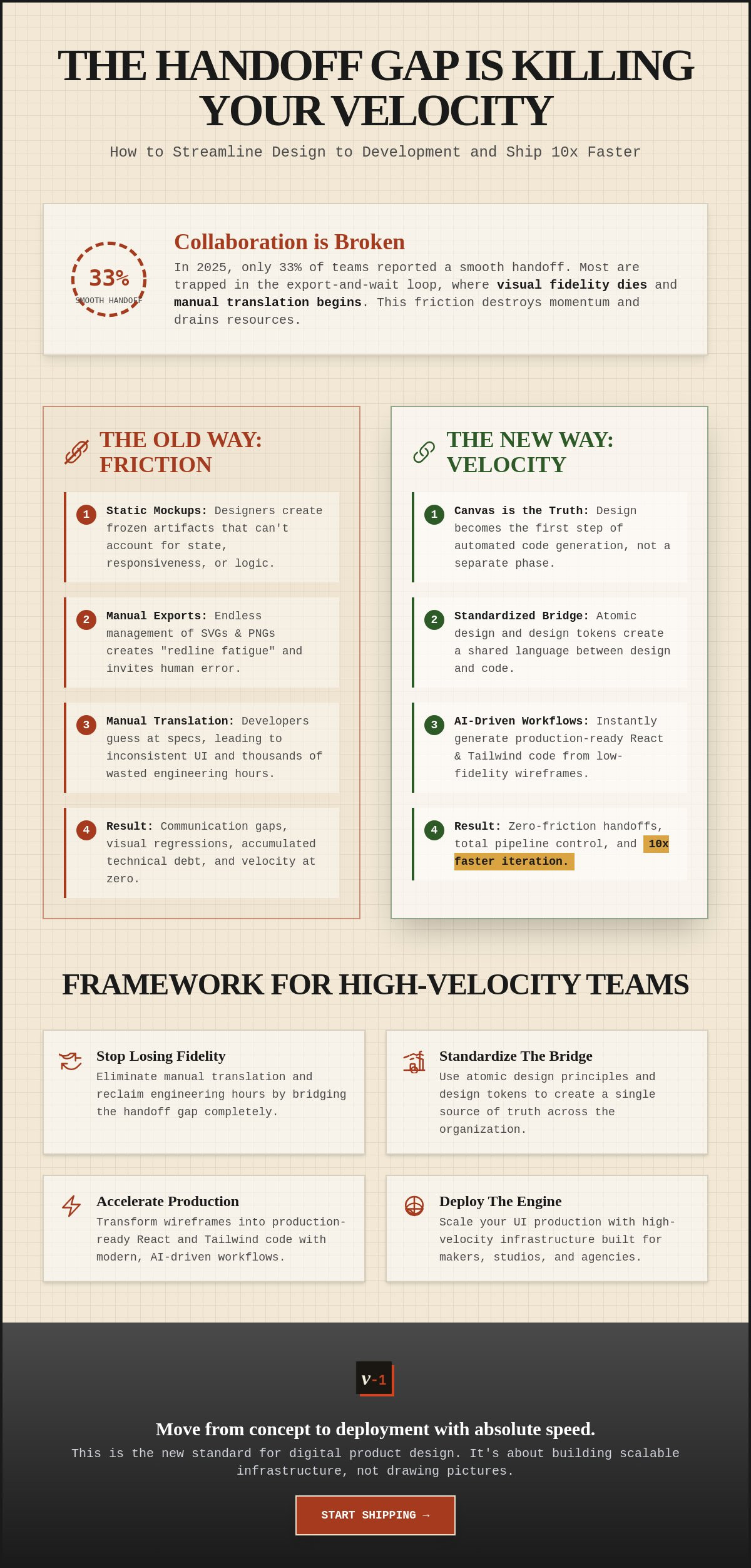
Collaboration is broken. In 2025, only 33% of teams reported a smooth handoff. Most are still stuck in the export-and-wait loop. Manual asset exports and inconsistent UI implementation are draining your momentum. Static mockups cause delays. Communication gaps kill velocity. It's time to streamline design to development by treating your canvas as the source of truth. Design is no longer a separate phase; it's the first step of automated code generation.
You've felt the fatigue of chasing pixel-perfect consistency across disconnected tools. We're here to end that cycle. This framework eliminates handoff friction and accelerates your production timeline. You'll gain total control over the pipeline while technology handles the heavy lifting in the background. We'll show you how to generate production-ready React and Tailwind code instantly. Expect zero-friction handoffs and 10x faster iteration cycles. This is how high-performance teams build in 2026. We're moving from concept to deployment with absolute speed. Let's start shipping.
Key Takeaways
- Stop losing fidelity. Eliminate manual translation and reclaim engineering hours by bridging the handoff gap.
- Standardize the bridge. Use atomic design principles to streamline design to development across your entire organization.
- Accelerate production. Transform low-fidelity wireframes into production-ready React and Tailwind code using modern AI-driven workflows.
- Audit for speed. Identify specific friction points and sync your design libraries with production component kits for total alignment.
- Deploy the engine. Scale your UI production using high-velocity infrastructure built specifically for makers, studios, and agencies.
The Design-to-Development Gap: Why Traditional Handoffs Fail
Traditional handoffs are a bottleneck. They represent a fundamental disconnect between vision and execution. We call this the 'Handoff Gap'. It is the precise moment where visual fidelity dies and manual translation begins. Designers ship a vision. Developers receive a puzzle. This friction destroys velocity. To streamline design to development, you must eliminate the translation layer entirely. Static mockups are dead. They are frozen artifacts in a fluid world. They cannot account for state, responsiveness, or logic. Relying on them creates a massive debt of inconsistent UI implementation.
Manual translation is expensive. It consumes thousands of engineering hours annually. Research from 2025 indicates that 40% of users still find themselves fixing low-quality AI output or manual errors during implementation. This isn't just a workflow issue; it's a financial drain. Modern product teams are adopting DevOps principles to bridge this divide. Automation is the only way forward. Speed requires a single source of truth where design and code exist in the same ecosystem. Inconsistent design systems act like sand in the gears. If the design library doesn't match the production component kit, the handoff fails. Engineers build custom overrides. Technical debt accumulates. Velocity drops to zero.
The Hidden Cost of Manual Exporting
Asset management is a productivity killer. Exporting SVGs and PNGs manually is a legacy task that has no place in 2026. It leads to 'Redline' fatigue. Engineers squint at documentation to guess padding, margins, and hex codes. This manual work invites human error. One wrong export leads to visual regressions. These bugs are costly to fix once they reach production. You need a system that handles assets automatically.
- Eliminate SVG/PNG management fatigue.
- Reduce documentation overhead for engineering teams.
- Prevent visual regressions before they reach the stage environment.
Why 'Pixel Perfect' is the Enemy of Speed
Stop chasing static perfection. It is a mirage. Shift your focus to functional, fluid systems. Component-based thinking is the foundation of high-velocity teams. Don't design pages. Build systems. 'Production-First' design means your canvas reflects actual code constraints from day one. When you streamline design to development, the design becomes the code. Perfection is found in the system, not the screenshot. High-growth tech circles prioritize execution over theory. They move from concept to assembly in hours, not weeks. This is the new standard for digital product design. It's about building scalable infrastructure, not drawing pictures.
Standardising the Bridge: Design Systems and Production-Ready Assets
Speed requires a shared language. A robust design system isn't a luxury; it's the core infrastructure for velocity. It allows teams to manage design at scale without losing momentum. To streamline design to development, you must build on atomic principles. Break the UI down. Start with atoms like buttons and inputs. Move to molecules. Assemble organisms. This hierarchy ensures every element is reusable and predictable. It creates a modular library that scales with your product. You no longer build from scratch. You assemble from a proven kit.
Parity is the goal. Use design tokens for colors, spacing, and typography. Tokens act as variables that exist in both design files and codebases. This ensures the implementation matches the intent perfectly. Mapping these styles to Tailwind utility classes or CSS-in-JS frameworks removes the interpretation layer. A designer selects a predefined spacing value. The developer applies the corresponding class. The result is instant. There is no negotiation. There is only execution. This methodology mirrors the 17% growth in developer employment projected through 2033; teams must become more efficient to handle the increased demand for digital products.
Tokenization: The Single Source of Truth
Design tokens are the DNA of your product. They eliminate naming conflicts and human error. "Brand-Primary" in your design environment must be "Brand-Primary" in your CSS variables. This creates a direct bridge between your design tool and VS Code. Automation is the final step. When a designer modifies a token, the change propagates through the pipeline. It pushes to the repository. It updates the production environment. No manual tickets are required. No Slack threads are needed. The technology handles the synchronization while you focus on the vision.
Building a Component-First Culture
Stop designing pages. Pages are static artifacts that don't scale. Components are functional units. Align your design libraries with React or Vue structures from the start. Every asset on your canvas must have a corresponding code snippet ready for deployment. This modular approach is essential for 10x faster iteration cycles. If a component isn't in the library, it shouldn't be in the design. High-velocity teams use UI production engines to maintain this alignment. It ensures that what you see is exactly what you ship. This is how you streamline design to development in a high-growth environment. You build systems, not just screens. You ship components, not just mockups.
AI-Driven Workflows: Accelerating Prompt to Production
AI is the catalyst. It transforms the "handoff" into a "generation." 84% of professionals already use or experiment with AI in their workflows. 78% report that these tools significantly speed up their production cycles. We're moving beyond experimentation. We're operationalizing intelligence. To streamline design to development, you must integrate AI directly into the pipeline. It's not about replacing the designer. It's about empowering them to direct the output. You skip the manual labor. You focus on the architecture. The machine handles the assembly.
The transition from concept to functional prototype used to take days. Now, it takes minutes. AI interprets your intent. It maps your visual vision to your technical constraints. It bridges the gap between a creative spark and a deployable asset. This is high-velocity product development. It's lean. It's fast. It's precise. You maintain total control while the heavy lifting happens in the background. The result is a total lack of friction in your creative process.
Generative UI: The End of Manual Mockups
Stop drawing every state. Use generative AI to turn low-fidelity wireframes into high-fidelity UI instantly. It produces rapid variations in seconds. You maintain brand consistency through defined style prompts. This is the shift from 'drawing' to 'directing'. You provide the intent; the engine provides the execution. High-growth teams use AI Studio Credits to fuel this transformation. It's about scale. It's about volume. It's about moving at the speed of thought. You iterate faster because the cost of exploration is near zero.
Mapping Design Intent to Code Logic
AI doesn't just copy pixels. It translates them. It analyzes spatial relationships on your canvas. It maps those relationships to semantic HTML and modern CSS. You get clean, accessible code. It identifies patterns. It suggests component reuse based on your library. AI understands layout structures for Flexbox and Grid logic automatically. It builds responsive breakpoints based on your standard containers. It even generates technical documentation alongside visual assets.
This automation ensures that your design becomes the code. It maps visual styles to your existing frameworks with surgical precision. You don't just get a mockup; you get a React component. You get Tailwind classes. This is how you streamline design to development in 2026. You leverage the machine to handle the repetitive boilerplate. You stay focused on the user experience. The flow is constant forward motion. Execution is the only metric that matters.
Operationalizing Speed: A 5-Step Framework for Modern Teams
Speed is not a byproduct of luck. It is the result of a deliberate, high-performance system. Most teams fail because they treat design and engineering as separate territories. They rely on "handoff days" that stall momentum. To streamline design to development, you must replace these static events with a continuous pipeline. This framework moves beyond the slow, physical models of the past. It prioritizes digital agility and immediate execution. You don't just build a product; you build an engine for production.
Execution is the only metric that matters. Follow these five steps to operationalize your velocity:
- Audit: Map your current workflow. Identify every moment where a human has to manually translate an idea into a task. These are your friction points.
- Sync: Ensure your design library is a perfect mirror of your production component kit. Parity is mandatory. If a component doesn't exist in code, it shouldn't be in your high-fidelity mockups.
- Automate: Deploy tools that generate production-ready React or Tailwind code directly from your canvas. The goal is zero manual translation.
- Validate: Use automated visual regression testing. This catches implementation errors before they reach the staging environment. Parity must be verified, not assumed.
- Iterate: Close the loop. Feed production data and user performance metrics back into the design phase. Refinement happens in real-time.
Eliminating the 'Big Bang' Handoff
The massive, multi-page release is a relic. It creates bottlenecks and invites error. High-velocity teams move to continuous integration for design assets. You ship small, frequent updates. This keeps the codebase fresh and the design intent clear. Developers don't wait for a zip file. They pull assets directly from the design tool as they are approved. This streamline design to development approach ensures that the "latest version" is always the "live version." There is no version lag. There is only progress.
The Developer-in-the-Design-Room Strategy
Involve your engineers early. They shouldn't see the design for the first time when it's "finished." Bring them into the generative phases. Engineers provide technical feasibility checks before you invest hours in high-fidelity polish. This prevents late-stage redesigns that kill timelines. You foster a model of shared ownership. The interface is a joint venture between creative vision and technical logic. It's about building a high-speed infrastructure for UI production where everyone is aligned from the first prompt. This is how you move from concept to deployment without hitting the brakes.
v-1.design: The Ultimate Infrastructure for High-Velocity Product Teams
Velocity requires the right engine. v-1.design is that engine. It acts as a silent, powerful partner in your development stack. It handles the heavy lifting while you maintain total control. You don't just use it; you deploy it. This infrastructure is built for those who prize execution over theory. To streamline design to development, you need a system that speaks both languages natively. No more manual exports. No more redline fatigue. The technology handles the synchronization in the background. You focus on the architecture. We handle the assembly. It is the end of the traditional handoff.
Execution is the only metric that matters in 2026. The market for UI design is projected to reach $11.31 billion by 2035. Teams that can't move fast will be left behind. v-1.design provides the high-performance aesthetic your brand needs. It strips away the friction of traditional creative processes. It feels futuristic, decisive, and results-oriented. You move from a starting concept to a finished result in rapid succession. This is the new standard for digital product design. It is lean. It is fast. It is immediate.
Scalable Design for Makers and Studios
The Maker Subscription is built for lean, high-output founders. It provides the essential tools for rapid prototyping and deployment. You move from vision to code without hitting the brakes. For teams scaling their output, the Studio Subscription is the industry standard. It enables agency-level UI production at extreme speeds. It removes the 'handover' from the equation entirely. You design. The code follows. For large-scale operations, the Agency Subscription provides the necessary scale to manage complex systems across multiple products. It is the high-velocity engine for modern product teams that demand zero-friction workflows.
Unlock Advanced Generative Features
Creative output scales with intelligence. Use AI Studio Credits to 10x your iteration cycles. These credits fuel the generative capabilities that turn concepts into production-ready SaaS interfaces. You don't just explore variations; you generate them. AI maps your visual intent to your existing code frameworks with surgical precision. This is the end of the manual mockup era. You direct the vision while the AI handles the assembly. It is about volume. It is about moving at the speed of thought. You iterate faster because the cost of exploration is near zero. High-growth tech circles don't wait for manual updates. They automate. They deploy. They win. Start streamlining your workflow with v-1.design and ship faster than ever before. This is the high-velocity workflow for 2026.
Ship Faster: The New Standard for Digital Production
The gap between vision and execution is closed. You've seen the cost of manual translation. You've identified the friction in static mockups. High-velocity teams don't wait for handoffs. They build systems. They leverage atomic principles and tokenized truth to maintain absolute parity. This is the only way to streamline design to development in a market that demands immediate results. Execution is everything.
Automation is the engine. AI handles the heavy lifting. You stay in control while your stack generates production-ready code. Whether you're a founder on the Maker Subscription or an enterprise scaling through an Agency Subscription, the infrastructure remains the same: zero-friction, high-speed, and total efficiency. It's time to stop drawing and start deploying. Use AI-powered generative design tools to eliminate the bottleneck for good. This is the high-speed, zero-friction UI infrastructure your team deserves.
Scale your UI production with v-1.design.
The future of product development is lean. It is fast. It is yours to command. Let's build.
Frequently Asked Questions
What does it mean to streamline design to development?
To streamline design to development means removing the translation layer between a mockup and a repository. You replace manual handoffs with an automated pipeline. Design intent becomes production-ready code instantly. This eliminates the "Handoff Gap" where visual fidelity is lost. It ensures your live product matches the canvas perfectly. Speed is the priority. Efficiency is the result.
How can AI improve the design-to-code workflow?
AI automates the repetitive boilerplate tasks that stall momentum. It interprets layout structures and maps them to modern CSS logic. According to 2025 research, 78% of professionals say AI tools significantly speed up their workflows. You move from a low-fidelity wireframe to a functional prototype in minutes. It shifts your focus from drawing to directing. The machine handles the assembly.
What are design tokens and why are they important for developers?
Design tokens are the DNA of your interface. They are variables that represent colors, spacing, and typography across both design and code. They provide a single source of truth. When you update a token, the change propagates through the entire system. This ensures absolute parity between Figma and your codebase without manual tickets. It prevents naming conflicts and human error.
Can AI generate production-ready React code from a design?
Yes. High-speed engines now generate production-ready React and Tailwind code directly from visual assets. These tools analyze spatial relationships and output semantic HTML. They handle Flexbox and Grid logic automatically. You get clean code that reflects your design constraints. This removes the need for engineers to guess padding or margins manually. Execution becomes immediate. Translation becomes obsolete.
How do I choose between a Maker and Studio design subscription?
Choose based on your production scale. The Maker Subscription fits lean founders who need high-output prototyping. The Studio Subscription is built for agencies scaling UI production for multiple clients. Both plans leverage the same high-velocity infrastructure. If you need to manage complex systems at scale, the Studio tier provides the necessary horsepower. Match the plan to your required velocity.
Will automated design tools replace frontend developers?
No. Automation handles the repetitive assembly. It frees developers to focus on complex logic and system architecture. Experts shift from building buttons to directing high-performance engines. It's about augmenting professional skills. Human expertise remains critical for validating output and refining the user experience. You spend less time on pixels and more time on performance. The role evolves.
How do I implement a design system without slowing down my team?
Start with atomic principles. Build a modular library of reusable components. Sync your design library with your production kit from day one. This "Production-First" approach prevents technical debt. Small, frequent updates are better than massive releases. You build the system while shipping the product. Velocity remains constant. Use a kit that is already code-ready to save time.
What is the fastest way to bridge the gap between Figma and code?
Deploy a high-speed infrastructure that connects your design tool to your codebase. This is the fastest way to streamline design to development in 2026. Use continuous integration to pull approved assets directly into the repository. Automation handles the heavy lifting. You achieve zero-friction handoffs and ship 10x faster iteration cycles. This methodology ensures the latest version is always the live version.
